
 English
 Español
 Português
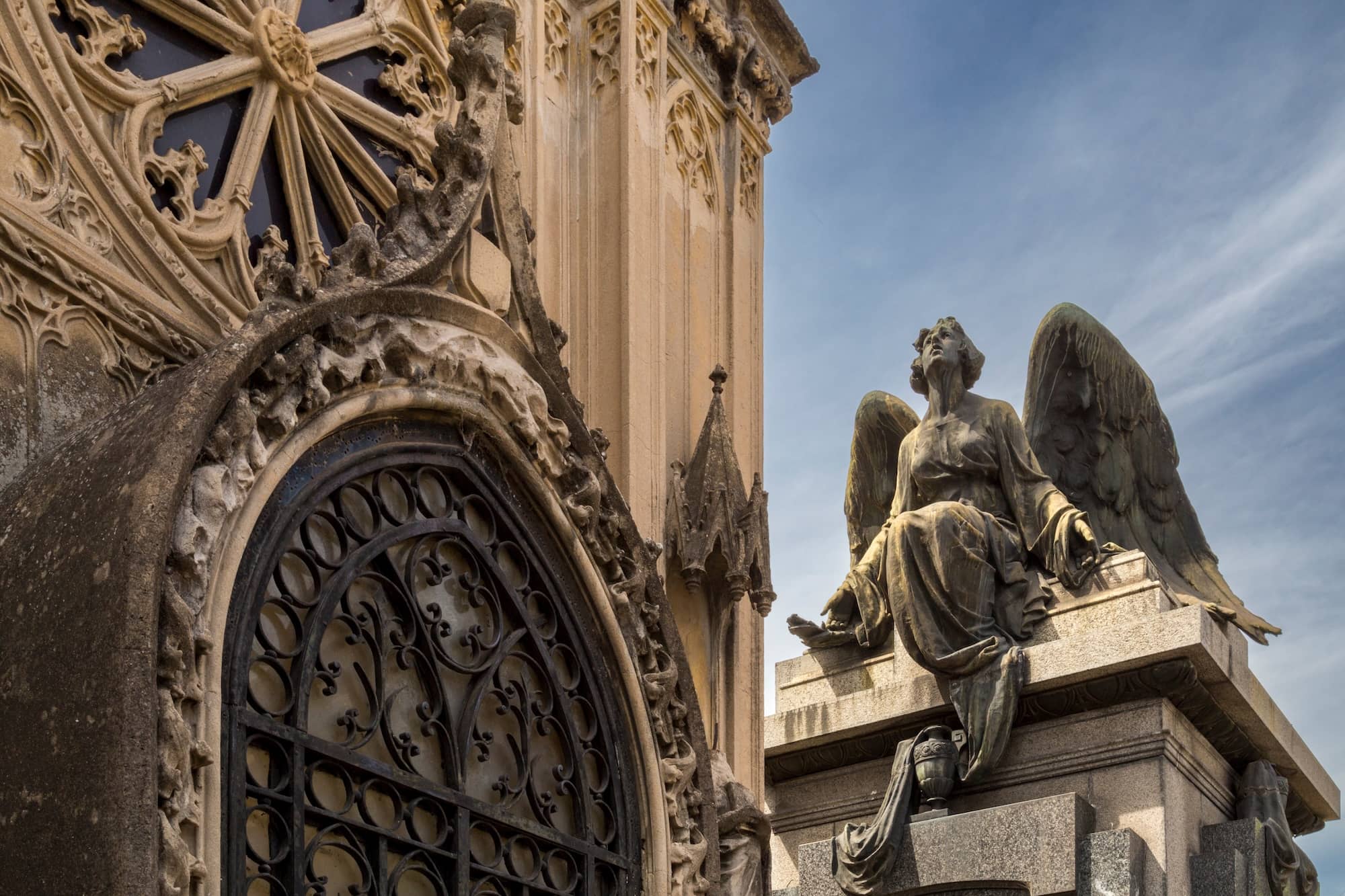
Recoleta Cemetery is one of the most visited highlights in Buenos Aires, famous for its stunning architecture and the famous figures buried there. Many people refer to it as a miniature city of mausoleums and monuments where the remains of Argentina’s elite, influential families, and historic personalities rest.
Spanning four city blocks, the cemetery dates back over 200 years. It contains around 4,700 tombs, with 75% still in use.
Once far away from the city center, this was a peaceful riverbank property surrounded by nature. Now, with the development of the city, it is not like that anymore, but there are still testimonies of the past: 150-year-old ombú trees.
This blog post will guide you through its layered history, symbolic artistry, dramatic tales, and practical tips for experiencing this fascinating place firsthand.
Are you looking for a guided tour? Check out my recommendation here.
| My Quick Recommendations for your travel to Buenos Aires!👇 🏡 Find the Best and Most Affordable Stays in Buenos Aires here! 🚗 Rental Car: The top Argentina & Budget companies are listed on this page. 📱 Connect: Stay connected, and get a 5% automatic discount, with the Argentina eSim! 💃 The Best tango show ticket prices available in Buenos Aires. |
The Origins of Recoleta Cemetery
The origins of the cemetery date back to 1705, when Franciscan monks erected a convent on this site, naming it El Convento de la Recolección.
Their complex included a church (Iglesia del Pilar), a monastery, and large gardens. For over a century, this area served as a quiet religious retreat.
Following independence in the early 1800s, the increasing concerns about sanitation prompted Governor Martín Rodríguez to ban church burials. In 1822, the convent’s grounds became the city’s first public cemetery, called Cementerio del Norte.
Recoleta Cemetery looked quite different in its early days, with a simple adobe wall and grassy plots. A major renovation in 1881 transformed it into the elegant necropolis visitors see today, complete with a grand entrance, brick perimeter, paved walkways, and elaborate mausoleums.
It’s a place where history and art come together-don’t miss the modest early tombstones, often with English inscriptions, tucked among the grand family vaults.

Recoleta Cemetery and the Formation of a Nation
By the mid-19th century, Recoleta Cemetery had evolved into a mirror of Argentine society. Its tombs began to reflect not just wealth, but power, ideology, and ambition. This was the age when Argentina was forging its national identity, experimenting with governance, facing invasions, and expanding its frontiers.
Families who had influenced the nation’s direction, the military class, the political elite, intellectuals, and clergy, claimed their spaces within the cemetery walls. Even the layout changed. In 1881, under the leadership of Mayor Torcuato de Alvear, a grand architectural overhaul replaced dirt paths with tiled walkways. The entrance was redesigned in classical style, and mausoleums multiplied in both size and grandeur.

Architecture and Symbolism
One of the first things visitors notice about Recoleta Cemetery is the extraordinary variety of architectural styles. Far from uniform, the mausoleums here blend neoclassical façades with Gothic spires, Egyptian obelisks, Byzantine domes, and Art Deco geometry. Many resemble miniature chapels or cathedrals, complete with stained glass and ironwork.
These tombs weren’t just built to honor the dead—they were constructed to impress the living. The wealthier the family, the more elaborate the mausoleum. In some cases, architects who had designed national monuments were commissioned to build family vaults.

But it’s the symbolism that truly elevates the cemetery’s visual language. An inverted torch symbolizes life extinguished. A winged hourglass warns that time is fleeting. Moths represent the soul’s journey toward light, and serpents devouring their own tails speak of eternity. Masonic symbols also appear, reflecting the influence of freethinkers and political radicals buried here.
Every statue and motif offers a silent sermon. Angels ascend, owls keep vigil, and draped urns mourn in silence. This blend of artistic expression and symbolic meaning makes Recoleta Cemetery not only a historical site but also a spiritual and cultural museum.

Recoleta Cemetery’s Most Iconic Residents
Perhaps no figure draws more visitors than Eva Perón, Argentina’s most controversial and beloved First Lady. After her death from cancer in 1952, her embalmed body was hidden, stolen, smuggled to Europe, and finally returned to Argentina decades later. Today, she rests deep within the Duarte family tomb—one of the most visited spots in Recoleta Cemetery.
But Eva is just one of many fascinating individuals interred here:
- Domingo Faustino Sarmiento – A former president and educational reformer, Sarmiento helped shape modern Argentina’s school system.
- Raúl Alfonsín – The first democratically elected president after the military dictatorship, Alfonsín’s tomb still attracts admirers.
- Luis Federico Leloir – Nobel Prize winner in chemistry, known for his work in sugar nucleotides and metabolism.
- Bartolomé Mitre – A key figure in the War of the Triple Alliance and founder of La Nación, one of Argentina’s most influential newspapers.
- Julio Argentino Roca – Controversial military leader and president, responsible for the expansionist “Conquest of the Desert.”
- Luis Ángel Firpo – The “Wild Bull of the Pampas,” Argentina’s legendary heavyweight boxer, immortalized in sculpture.
Each tomb is a doorway into a biography—and collectively, they tell the national story better than most textbooks.

Legends, Myths, and Mystery
Recoleta Cemetery is rich in history, but it’s also a magnet for legends. One of the most haunting is the tale of Rufina Cambacérès, a 19-year-old socialite who reportedly woke up in her coffin, having been mistakenly declared dead. Her Art Nouveau tomb shows her trying to open a door—a chilling nod to the rumor that she was buried alive.
Another tale centers on Liliana Crociati, who died tragically in an avalanche in Austria. Her statue shows her in a wedding dress beside her beloved dog, Sabú. The tomb, with its Gothic styling and emotional resonance, is a magnet for photographers.
More grimly, the cemetery has witnessed body thefts, most notably that of Pedro Aramburu, a former president and military leader. His casket was stolen by political militants in the 1970s—an act that inadvertently led to the return of Eva Perón’s remains.
These stories blend fact with folklore, reminding us that memory is as much about mystery as it is about truth.

When to to visit Recolata Cemetery?
If you’re planning a visit, here’s what you need to know about exploring Recoleta Cemetery today.
- Opening Hours: Daily from 9:00 AM to 5:00 PM
- Admission Fee: +/- 15 USD (subject to change) for non-residents. Purchase of the ticket is at the cemetery itself.
- Best Time to Visit: Early morning or late afternoon for fewer crowds and beautiful lighting.
While the cemetery is walkable in a couple of hours, many visitors spend the better part of a day wandering through its sectors. Photography is allowed and encouraged—just be respectful. The site is an active cemetery, and funerals do occur.
Be sure to pick up a map at the entrance or download a guide in advance. While the major tombs are well-known, many hidden gems exist along side alleys and quieter corners. Pack water, especially in summer, and avoid visiting during rain—there is little shelter.
Fixed price per vehicle · Free cancellation up to 24 h


